
Eight Dimensions, One Specification
How Spectral Brand Theory dimensions become config parameters


Every line of YAML in your operational specification is a brand signal. Here is exactly which dimension of brand perception it affects.
This is not an abstract claim. The Spectra Coffee (a synthesized specialty coffee shop used throughout this series as an illustrative example) demo contains 25 YAML files specifying a complete coffee operation. Every parameter in those files maps to at least one of Spectral Brand Theory’s eight perception dimensions. This article walks through the mapping.
The eight dimensions
Spectral Brand Theory measures brand perception across eight observer-dependent dimensions:
Experiential: Direct sensory and functional experience (taste, touch, speed, comfort)
Semiotic: Visual and symbolic language (logo, colors, typography, naming)
Temporal: Time-based patterns (innovation cadence, consistency, heritage)
Ideological: Values, ethics, and beliefs (sustainability, fairness, transparency)
Narrative: Stories and mythology (founder’s story, origin narratives, brand mythology)
Cultural: Community and cultural context (local adaptation, rituals, belonging)
Social: Interpersonal and tribal dynamics (staff interaction, community recognition)
Economic: Pricing and value perception (premium positioning, cost-value ratio)
Each dimension is perceived differently by different observer cohorts. The morning regular weighs experiential and temporal (consistent quality, quick service). The weekend explorer weighs the full spectrum. The delivery app customer sees only economic (price) and experiential (taste upon arrival). The food inspector sees only compliance (binary pass/fail).
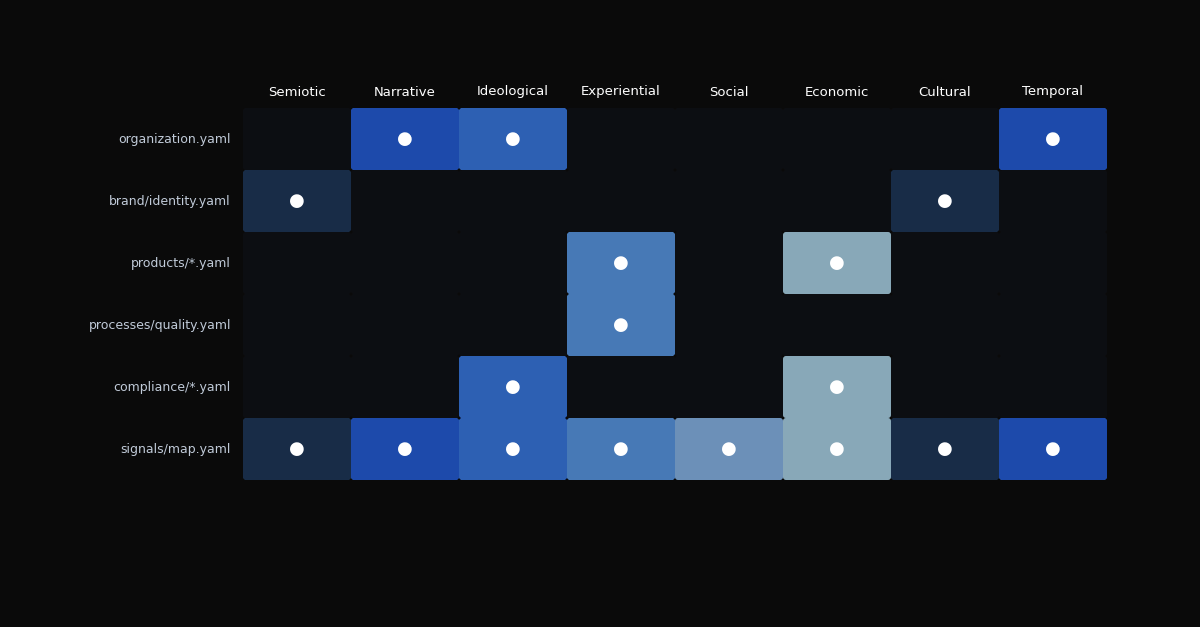
Eight SBT dimensions mapped to orgschema YAML files: 19 explicit operational signals covering all perceptual dimensions.
Dimension 1: Experiential
The experiential dimension is the densest in the specification. It covers everything the customer directly senses and functionally experiences.
Product specifications dominate this dimension:
# products/espresso.yaml
preparation:
  extraction_time_seconds: [25, 30]    # Taste quality
  temperature_celsius: [92, 94]        # Flavor extraction
  dose_g: [17, 19]                     # Body and intensity
ingredients:
  coffee_beans:
    variety: “heirloom”                # Flavor complexity
    processing: “washed”               # Clean cup profile
Every parameter here is an experiential signal. The extraction time determines whether the coffee tastes balanced or over/under-extracted. The temperature determines flavor compound extraction. The bean variety determines flavor complexity. These are not operational details — they are the experiential dimension of the brand, encoded as testable contracts.
Process specifications also contribute:
# processes/quality_control.yaml
grinder_calibration:
  frequency: “daily”                   # Consistency across cups
espresso_quality_gate:
  visual_check: “crema_color_hazelnut” # Visual quality indicator
Environment signals:
# brand/identity.yaml
interior:
  temperature_celsius: [20, 22]        # Physical comfort
  lighting: “warm, dimmable”           # Atmosphere
  seating_comfort: “upholstered”       # Duration encouragement
Experiential is Spectra Coffee’s highest-scoring dimension (9/10) because the majority of the operational specification serves it.
Dimension 2: Semiotic
The semiotic dimension covers the visual and symbolic language. This is the traditional domain of brand strategy — and the only dimension most brand agencies manage.
# brand/identity.yaml
visual:
primary_color: “#2C3E50” # Color palette
secondary_color: “#ECF0F1”
accent_color: “#E74C3C”
typeface_heading: “Playfair Display” # Typography
typeface_body: “Inter”
logo_clearance: “2x logo height” # Spacing system
packaging:
takeaway_cup: “kraft paper, embossed logo”
bag: “matte black, foil-stamped”
signage:
exterior: “illuminated, minimal”
menu_board: “hand-chalked daily” # Craft signalThe semiotic dimension also includes non-visual semiotics: the menu board hand-chalked daily is a semiotic signal of craft (not just a menu delivery mechanism). The packaging materials communicate quality positioning through texture and weight.
In the signal map, semiotic signals include: semiotic.visual_coherence, semiotic.material_quality, semiotic.naming_system.
Dimension 3: Temporal
The temporal dimension covers time-based perception: innovation cadence, consistency across visits, heritage signaling.
# products/espresso.yaml (and seasonal variants)
seasonal_blend:
rotation: “quarterly” # Innovation cadence
current: “Spring 2026 - Yirgacheffe Natural”
# processes/quality_control.yaml
consistency_validation:
extraction_variance: “< 3 seconds across staff” # Visit consistency
taste_calibration: “weekly cupping session”Temporal signals are partially specified and partially emergent. The quarterly blend rotation is explicit. The consistency across visits is validated by the variance threshold. But the temporal dimension also includes the customer’s accumulated experience over time — which is not in the specification but is measured in the spectral profile.
The git log itself is a temporal artifact: git log --since="6 months ago" shows the innovation cadence of the specification. Frequent commits to product files indicate active menu development (temporal signal: innovative). Stable process files indicate operational consistency (temporal signal: reliable).
Dimension 4: Ideological
The ideological dimension covers values, ethics, and beliefs the brand embodies.
# organization.yaml
values:
- “craft_excellence”
- “ethical_sourcing”
- “environmental_responsibility”
# products/espresso.yaml
ingredients:
coffee_beans:
certification: “direct_trade” # Ethical sourcing signal
origin: “Ethiopia, Yirgacheffe” # Provenance transparency
# L5 sourcing
sourcing:
coffee:
relationship: “direct_trade”
minimum_price_premium: “25% above commodity”
visit_frequency: “annual farm visit”The ideological dimension is where sourcing (L5) becomes a brand signal. The customer does not experience the farm visit directly. But the knowledge that the business visits its suppliers annually, pays 25% above commodity price, and sources direct-trade coffee produces an ideological signal: this business has values.
Constraint contracts also contribute to the ideological dimension:
# L0 commitment contracts
commitment_contracts:
  sustainability:
    packaging: “100% compostable or reusable”
    energy: “renewable electricity supplier”
    waste: “zero food waste to landfill”
These are not regulatory requirements. They are self-imposed commitments that emit ideological signals.
Dimension 5: Narrative
The narrative dimension is the least specifiable. It covers stories, mythology, and founder narratives.
# organization.yaml
mission: “Exceptional coffee through transparency, craft, and specification”
founded: 2026
founder_story: “A software engineer who applied TDD to coffee”
The mission and founder story are in the specification. But the narrative dimension is primarily produced through communication, not operations. The blog post about visiting the Ethiopian farm. The Instagram story about the new seasonal blend. The barista’s explanation of why they chose washed processing over natural.
Orgschema does not fully capture the narrative dimension. This is acknowledged as a limitation — narrative is emergent from human communication and cultural production, not from operational contracts. The specification provides the factual foundation (origin, process, values) from which narratives are constructed.
Dimension 6: Cultural
The cultural dimension covers community role, local adaptation, and cultural rituals.
# locations/friedrichshain/overrides.yaml
local_adaptation:
language: “German primary, English secondary”
local_events: “monthly neighborhood coffee tasting”
community_board: “local events posting”
# organization.yaml
community:
role: “neighborhood gathering space”
local_sourcing: “bakery from Backhaus Sievert (2 blocks)”The cultural dimension is where location forks become brand decisions. The Friedrichshain location sources pastries from a local bakery (cultural signal: neighborhood integration). The original location might source from a central kitchen (no cultural signal). Same L2 process contracts, different L5 sourcing, different cultural dimension score.
Dimension 7: Social
The social dimension covers interpersonal dynamics: staff interaction, community recognition, belonging.
# processes/opening_closing.yaml
customer_interaction:
greeting: “acknowledgment_within_seconds: 10”
regular_recognition: “name_and_usual_by_third_visit”
farewell: “personalized, not scripted”
# organization.yaml
execution_profile: “human_artisan” # Human interaction, not automatedThe social dimension is the strongest argument for human execution. The executor profile human_artisan is not just an implementation choice — it is a brand decision that directly affects the social dimension. An automated espresso machine passes the same L2 extraction contracts but emits zero social signals. The executor swap scenario in the demo quantifies this: switching from human to automated execution drops the social dimension from 6 to 2.
Social signals are partially specifiable (greeting within 10 seconds, regular recognition by third visit) and partially irreducible (genuine warmth, authentic rapport, the barista who remembers your dog’s name). The specification captures the minimum. The human premium provides the rest.
Dimension 8: Economic
The economic dimension covers pricing, premium positioning, and value perception.
# products/espresso.yaml
pricing:
price: 3.50
currency: “EUR”
margin_pct: 78
# products/oat_latte.yaml
pricing:
price: 4.80
currency: “EUR”
margin_pct: 65The economic dimension is fully specifiable but its perception is observer-dependent. The morning regular perceives EUR 3.50 as fair (repeat purchase confirms value). The tourist perceives it as expensive or cheap relative to their home city. The delivery app customer adds the delivery fee and perceives a different value proposition entirely.
Pricing in orgschema is not just a financial parameter. It is a signal: premium pricing communicates quality expectation (economic-as-signal). Discount pricing communicates accessibility. The pricing strategy is a brand decision specified in the product YAML.
The unified view
Every YAML file in the specification maps to dimensions:
The signal map (signals/signal-map.yaml) contains 19 explicit signal mappings across all eight dimensions. The customer experience contract specifies targets for each dimension with proxy indicators. The CI/CD pipeline validates that operational specifications satisfy signal requirements and that signals satisfy experience goals.
This is the unification: one specification, eight dimensions, complete traceability. Every operational parameter has a spectral address. Every brand dimension has operational sources. The specification is the brand. The brand is the specification. They were never separate — orgschema just makes the connection explicit.
When the customer is not human
This eight-dimension mapping assumes a human observer. But OST is observer-agnostic — the TDD cascade works regardless of customer type. When the customer is a machine (an API consumer, a procurement algorithm, an AI shopping agent), the dimensions transform:
The human dimensions have noise, subjectivity, and path-dependence. The machine dimensions are deterministic. But in both cases, the operational specification (L2-L5) is identical. The same YAML. The same contracts. The same validation pipeline. Only L0-L1 change character — and for machine customers, they simplify.
This article is part of the convergence series bridging Spectral Brand Theory (perception measurement) and Organizational Schema Theory (operational specification).
SBT research paper: Zenodo preprint
OST research paper: Zenodo preprint
Open-source toolkits: SBT · Orgschema