
Harness Engineering for Business
What AI agent design teaches us about organizational specification


AI engineers discovered something counterintuitive: you cannot make a better coding agent by improving the model. You make it better by improving the environment. The constraints, the tools, the feedback loops, the test suites — the harness — determines performance more than the agent’s raw capability.
The same principle applies to your business. And it is the core insight behind orgschema.
The harness engineering parallel
In AI agent development, a “harness” is the environment in which an AI agent operates: the tools it can call, the constraints it must follow, the tests that validate its output, the feedback it receives. The field of harness engineering — designing these environments for maximum agent performance — has emerged as the critical discipline in building reliable AI systems.
The key findings from harness engineering research translate directly to organizational design:
Constraints improve performance. An AI agent with unlimited freedom produces worse results than one with well-designed constraints. The constraints are not limitations — they are the specification of what “good” looks like. A coding agent that must pass unit tests before merging produces better code than one that operates without tests. A barista who must satisfy a quality gate (extraction 25-30 seconds) produces better espresso than one with total freedom.
Environment design beats agent optimization. You can spend months improving the model (training a better barista, hiring more talented staff) and get marginal gains. Or you can improve the environment (better equipment, clearer specifications, tighter feedback loops) and get structural gains. The environment is the leverage point, not the agent.
Tests drive quality, not instructions. Telling an AI agent “write good code” produces mediocre results. Giving it a test suite and saying “make these pass” produces excellent results. Telling a barista “make good coffee” produces inconsistent results. Giving them a quality gate and saying “hit 25-30 seconds extraction with this dose” produces consistent results. Tests are more effective than instructions because they are verifiable.
Feedback loops must be tight. An AI agent that learns from production failures improves slowly and expensively. An AI agent that gets test results in seconds improves rapidly and cheaply. A business that discovers quality problems from customer complaints improves slowly. A business that validates operations against contracts on every commit improves continuously.
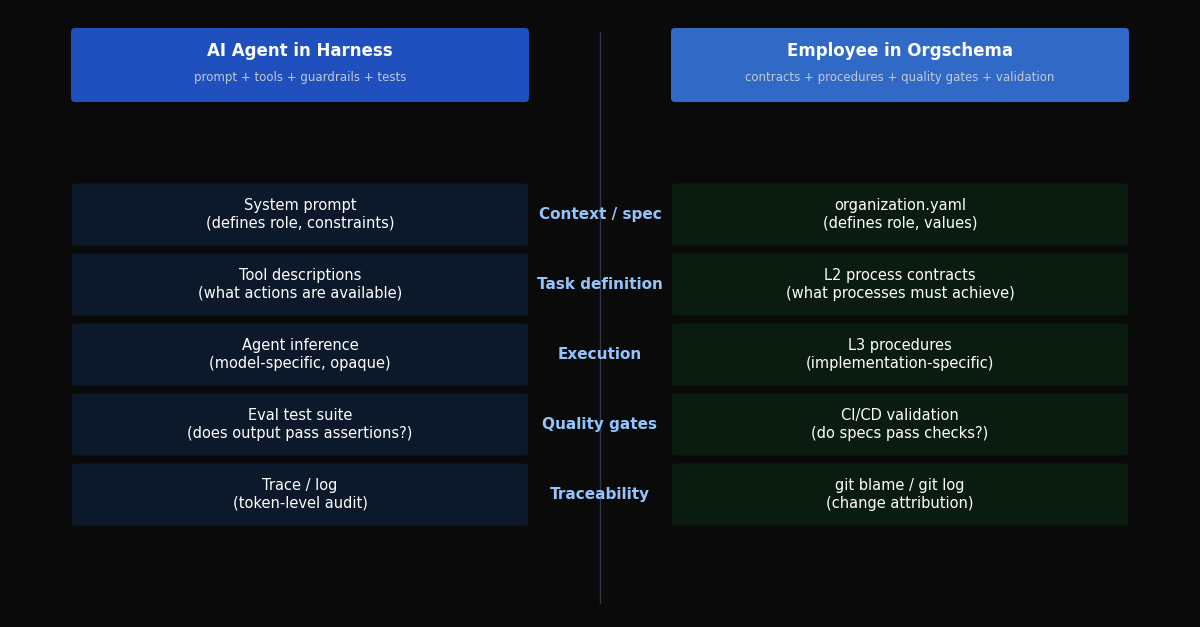
AI agent harness versus employee in orgschema: parallel structure of context, task definition, execution, quality gates, and traceability.
The reasoning sandwich
Harness engineering uses a pattern called the “reasoning sandwich”: invest heavily in planning (before execution) and verification (after execution), but let the execution itself be flexible. The agent can choose how to implement, but it must plan against the specification and verify against the tests.
Orgschema’s TDD cascade is a reasoning sandwich for business:
Planning (top-down specification): L0 customer experience contracts define the desired outcome. L1 signal requirements define what must be emitted. L2 process contracts define what must be achieved. This is the planning layer — invest heavily here.
Execution (flexible implementation): L3 procedures are how the contracts are implemented. Different executors (human, machine, hybrid) can implement the same contracts differently. Different locations can implement differently. The execution is flexible — the implementation is the executor’s domain.
Verification (continuous validation): The CI/CD pipeline validates that execution satisfies the contracts. The spectral profile measurement validates that the customer experiences the intended perception. This is the verification layer — invest heavily here.
The middle layer (execution) gets freedom. The outer layers (planning and verification) get investment. This is exactly the harness engineering pattern, applied to organizational design.
What AI agents and employees have in common
The parallel is not metaphorical. AI agents and human employees face the same fundamental challenge: executing tasks in a complex environment with incomplete information, competing priorities, and the need for consistent quality.
In both cases, the quality of the output depends more on the quality of the specification and the tightness of the feedback loop than on the raw capability of the agent.
A brilliant barista in a poorly specified environment (no quality gates, no traceability, no validation) will produce inconsistent results because there is no feedback mechanism to maintain quality. An average barista in a well-specified environment (clear contracts, daily calibration, continuous validation) will produce consistent results because the harness maintains quality.
This is not an argument against talent. It is an argument about leverage. Invest in both the agent and the environment, but understand that the environment has higher leverage.
Stabilization and growing autonomy
In harness engineering, new AI agents start with tight constraints and gradually receive more autonomy as they demonstrate competence. The first tasks are simple, heavily guided, with strict validation. As the agent builds a track record, constraints relax and the agent operates with more independence.
Orgschema’s maturity model (M0 through M5) follows the same pattern:
M0 (Tribal knowledge): No specification. The “agent” (employee) operates on memory and habit. No constraints, no tests, no validation. Maximum freedom, minimum consistency.
M1 (Schema): The specification structure exists but values are incomplete. The employee knows what should be measured, even if not all measurements are in place. Some constraints, no automated tests.
M2 (Contracts): Quality gates are defined. The employee knows what must be achieved. The CI/CD pipeline validates contracts. Constraints are clear, tests run automatically.
M3 (Procedures): Implementation is documented. The employee has both the “what” (contracts) and the “how” (procedures). But the procedures are guidance, not prison — the contracts are the binding constraint, and the employee can adapt the procedure as long as the contract passes.
M4 (Traced): Full traceability from every parameter to its customer experience justification. The employee understands not just what and how, but why. This understanding enables informed deviation — choosing to exceed the contract in ways that serve the experience goal even when the specification does not explicitly call for it.
M5 (Validated): Continuous measurement closes the loop. The spectral profile validates that the entire chain — from specification through execution to perception — is working. The harness is complete.
The progression from M0 to M5 is a growing autonomy pattern: start with specification (constraints), add validation (tests), add traceability (understanding), add measurement (feedback). At each level, the employee has more context and more freedom to exercise judgment — because the harness provides the safety net that makes freedom productive rather than risky.
The environment design priority
Harness engineering research consistently shows that improving the environment yields higher returns than improving the agent, up to a point. The same holds for organizations:
Equipment investment (L4 inputs): a better grinder produces more consistent extraction than more barista training. The equipment is the harness; the barista is the agent. Invest in the harness first.
Specification investment (L2 contracts): clear quality gates produce more consistent output than vague instructions. “Extraction 25-30 seconds” is a better harness than “make it taste good.” Invest in the specification.
Feedback investment (CI/CD validation): automated quality checking catches more issues than periodic audits. Continuous validation is a tighter feedback loop than quarterly reviews. Invest in the feedback mechanism.
Training investment (agent improvement): once the harness is good, training has higher marginal returns. A barista who understands the contracts, works with calibrated equipment, and receives continuous feedback improves faster than one trained in a chaotic environment. Train the agent last, not first.
This is not the conventional wisdom. Conventional management prioritizes people: “hire great people and get out of their way.” Harness engineering suggests: “design a great environment and put people in it.” Both matter. But the environment has higher leverage because it affects every agent simultaneously and permanently, while training affects one agent at a time and decays over time.
The AI agent connection
Orgschema’s specifications are not just for human employees. They are natively readable by AI agents. An LLM can traverse the TDD cascade, answer questions about any parameter, trace traceability chains, and even propose specification changes.
This creates a unique convergence: the same specification (the harness) serves both human employees and AI agents. The human barista reads the quality gate and uses judgment to exceed it. The AI agent reads the quality gate and validates that it is met. Both operate within the same specification. Both benefit from the same constraints.
As AI agents become more capable in physical-world tasks (robotic coffee preparation, automated inventory management, dynamic pricing), the orgschema specification becomes the shared operating environment for human and AI agents working side by side. The human handles the social dimension, the craft premium, the judgment calls. The AI handles the consistency validation, the data analysis, the compliance checking. Both reference the same specification.
Harness engineering for AI and orgschema for business are not parallel developments. They are the same development, applied to different agent types, using the same design principles. Constraints improve performance. Environment beats agent. Tests beat instructions. Feedback loops must be tight.
The discipline that AI engineers discovered for making coding agents reliable is the same discipline that makes coffee shops consistent. The harness is the specification. The specification is the harness.
This article is part of the convergence series bridging Spectral Brand Theory (perception measurement) and Organizational Schema Theory (operational specification).
SBT research paper: Zenodo preprint
OST research paper: Zenodo preprint
Open-source toolkits: SBT · Orgschema