
The Unbundled Think-Tank
A think-tank is two things in one building — the people who think, and the knowledge they think with. The interesting move is to split them.


When McKinsey, BCG, or Bain finishes an engagement, two things happen. You get a deck, and the people who made it walk out the door. The deck is a snapshot of their thinking at one moment, about your company, frozen the day it was bound. Six months later the market has moved, the analysis hasn’t, and the only way to update it is to buy another engagement. You paid for brains, knowledge, and a body to apply them — bundled together, and rented by the week.
That bundle made sense when the three could not be separated. They can be separated now. A think-tank, stripped to its parts, is two things: the people who think, and the body of knowledge they think with. For a century those lived in the same building because there was no other way to connect them. The reason to pull them apart is that one of the two parts — the thinking — is now something you already own.
The three parts, and whose they are
Once you split the building, a consultation has exactly three components, and the interesting question is who should own each one.
The lens is the part worth keeping open. It is the corpus of research, the methods, and the runnable instruments — and unlike a deck, it is versioned and kept current, so the science your AI reasons with is always the latest. The intellect is the part you already have: your own AI, the one your team is already using to think through hard calls. And your case — your figures, your strategy, the decision in front of you — is the part that should never have left your building in the first place.
In the traditional — monolithic — model, all three were aggregated inside the consulting firm. In the unbundled — decomposed — model, the lens sits in the cloud (on the consultant’s server, say) and is kept current, while the intellect and the case stay with you. In practice it is three simple steps: you choose the AI model — cloud or local — you give it access to your data, and you set the task; the model then works it through the lens it reaches by a link to the consultant’s server. Nothing to install, nothing to hand over — the whole engagement is a prompt with a link in it.
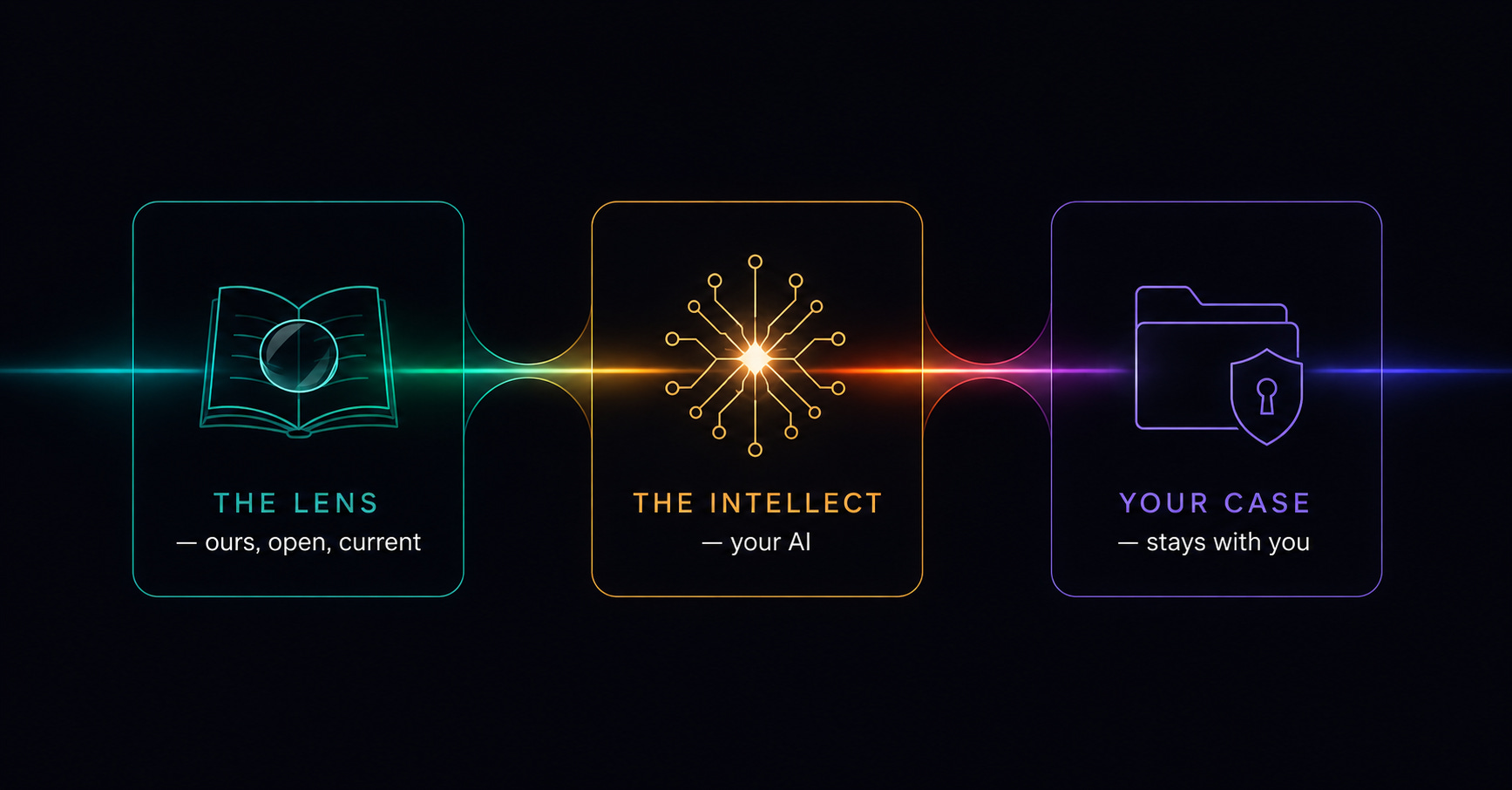
The think-tank, unbundled. The lens is ours and published; the thinking and the data stay yours — your AI reasons over an open, current corpus on a case that never leaves your side.
Not a book, not a chatbot, not an engagement that ends
Three things already try to do this job, and each fails in an instructive way.
A book — Good to Great, say — is knowledge without a live mind and without you. It is frozen the day it prints, it is about other companies, and it cannot be pointed at your situation. Jim Collins cannot re-run his analysis on your quarter. The lens is real, but it is dead and generic.
A generic chatbot is the opposite failure: a live mind anchored to nothing. Ask a raw model about your brand and it will answer confidently about everything, because it has no instrument to measure with and no floor below which it admits it cannot tell. It will never say “I don’t have the evidence for that.” It will produce a fluent number and you will have no way to audit where the number came from.
A consulting engagement has all three parts — lens, intellect, case — but it bundles them, rents them, and then leaves. The knowledge walks out with the people, and what stays is a static artifact you cannot update without paying again.
The unbundled model takes the one part worth keeping open — the lens — and keeps it attached and current, while the thinking and the data stay with you. Think of it the way a trading desk thinks about a Bloomberg Terminal: nobody wants to own the data plumbing, they want a maintained, trustworthy instrument they can reason over, while the trades and the judgment stay theirs. The lens is that instrument, for decisions about brand and operations.
The part that makes it trustworthy: it tells you what it can’t tell
Here is the feature that separates this from a smarter chatbot. The lens carries instruments, and every instrument knows its own floor — the level of noise below which it genuinely cannot tell two answers apart. When you bring a decision, the lens does not always return an answer. Sometimes it returns an honest cannot resolve, and names what evidence would settle it.
That sounds like a limitation. It is the entire value. A consultant who never says “I don’t know” is selling confidence, not analysis; a chatbot that never abstains is doing the same thing faster. When you ask whether two audiences really see your brand differently, or whether an acquisition fits in operations as well as in perception, the useful machine is the one that distinguishes a real finding from a gap that sits inside the noise — and tells you which is which. An answer you can trust is only worth as much as the “I can’t tell” that sits next to it.
Where the line is
The unbundled think-tank diagnoses and analyzes. You and your people decide and act. It is a positioning system — it tells you precisely where you are, not where you should go. That distinction matters, because the failure mode of the old model was a firm that quietly crossed from measuring your situation to running it, and then owned the knowledge of how. Measurement stays with the instrument; management stays with you.
Three first moves
You can start practicing the unbundled model this week without changing a single vendor.
Point your AI at an open lens, once. Take the decision your team is chewing on right now and give your AI the published corpus and instruments that bear on it, instead of asking it to free-associate. The difference between “what do you think about our brand” and “read this method, then measure our brand against it” is the difference between an opinion and an analysis.
Demand the abstention. Whatever tool you use, require it to tell you what it cannot conclude from the evidence, and what would change that. A team allowed to say “we can’t tell yet” is the only team whose “we found it” you can trust.
Keep your case in your building. The reasoning and the data are yours; only the lens needs to be shared. Make that your default and you get the benefit of an outside method without handing an outside party the inside knowledge.
The consulting engagement that walks out the door, the book that froze last year, the chatbot anchored to nothing — each is a different way of bundling the wrong things. Split the think-tank into its parts, keep the lens open and current, and leave the thinking and the data where they belong. What you are left with is an outside method that never leaves, applied by a mind you already own, to a case that stays yours.
The decision layer is live at Schema Consult: bring a business decision, it routes to the research that frames it and the instrument that measures it — and returns an honest “cannot resolve” when the evidence is thin. Its sibling instrument, the Brand Spectrometer, does the measuring.